Why Your Drywall Patches Keep Showing Through the Paint
That patched spot still showing through fresh paint isn't a paint problem — it's texture and skipped primer. Here's the fix, plus what storm stains really need.
The ghost rectangle
You know the ghost I'm talking about.
You patch the hole — the doorknob kiss on the hallway wall, the spot where the TV mount used to be — sand it smooth, roll a nice fresh coat over it... and there it is. A faint rectangle staring back at you every time the afternoon sun hits the wall. You painted right over it. Why can you still see it?
Here's the thing: that patch isn't a paint problem. It's a texture problem. And once you understand that, the ghost goes away for good.
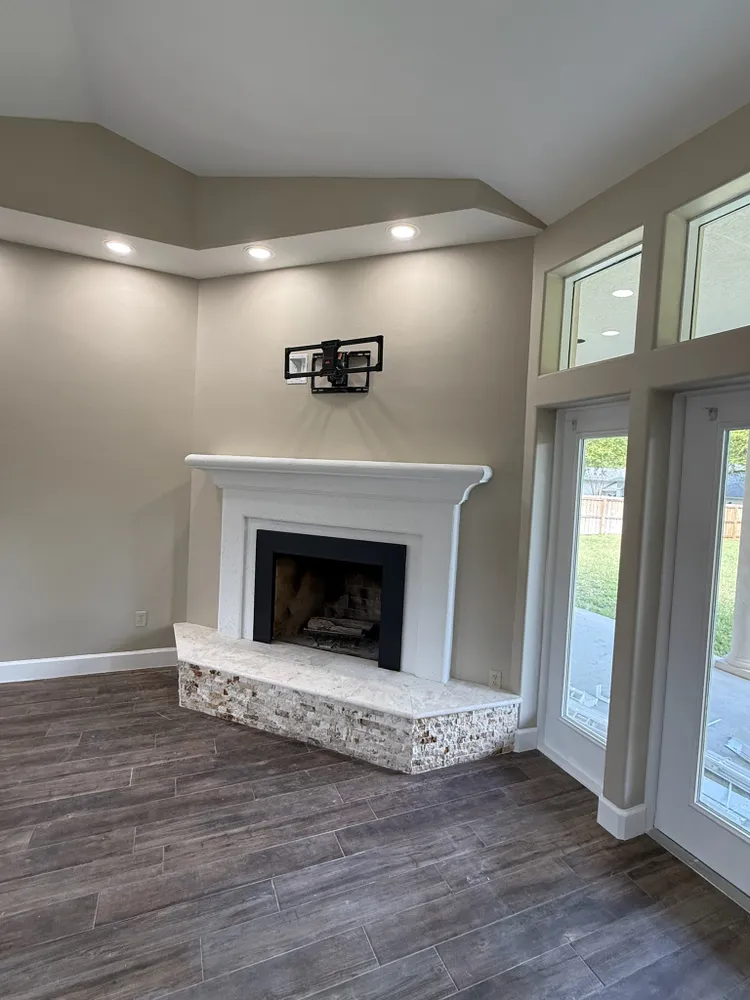
Primed, sealed, and rolled corner to corner — no ghost rectangle.
Why patches "show through" (it's not your paint)
A wall that's been rolled a few times has a slight texture to it — even if it looks flat, there's a little orange-peel stipple from the roller. Your patch, though? That mud went on glassy smooth. Paint doesn't hide that difference — it highlights it. Light coming across the wall at an angle catches the smooth spot and the stippled spot differently, and your eye reads it as a rectangle.
The second reason patches flash through: the mud and the wall drink paint at different rates. Bare joint compound is thirstier than the painted wall around it, so the same coat of paint dries with a slightly different sheen over the patch. Painters call that "flashing." It looks like the patch is glowing through.
Both problems have the same fix: primer. Not just paint — primer. A coat of primer seals the patch so it drinks the same as the wall, and it gives you a uniform surface for the topcoat. If you did the patch work right and skipped the primer, that's usually where the ghost came from.
The fix most people skip
Quick version, if you're doing it yourself: feather the patch edges with 150-grit sandpaper so you can't feel the lip, wipe the dust, hit it with primer (a stain-blocking primer is even better — it seals in one pass), then roll corner to corner. Painting the whole wall section from one corner to the other — not just the patch — is the part people skip. If you only paint the square, you'll trade the ghost rectangle for a slightly shinier square. Same problem, new shape.
Now — all of that is for normal wear-and-tear patches. The drywall damage we're seeing around here this week is a different animal.
The storm version: water stains aren't patch problems
Isaias came through on October 9th — a Category 2, 105 mph winds, landfall right up the coast near Destin. Around here that meant shingles shifted, flashing lifted, and water finding its way in. If you've got a brown or yellow ring blooming on a ceiling this week, that's not something to paint over on Saturday and forget.
First, that stain will bleed right through regular paint. Water stains laugh at latex — they'll ghost through three coats. You need a stain-blocking primer, and only after the source of the water is fixed. If the roof's still leaking, no primer on earth will hold.
Second — and this is the part that matters most — if the drywall actually got wet, that's not a painting job anymore. Soft, sagging, musty drywall has to be cut out and replaced, then primed and painted. Painting over wet drywall is just putting a lid on mold. You'll see it again in a few months, except now it smells like a basement and the patch is twice as big.
How do you tell? Press it. Dry drywall is solid. Wet drywall gives under your thumb like cardboard left in the rain. If it gives — or if it smells even a little musty — that section needs to come out before anyone opens a paint can.
The other tell is location: stains under windows, along exterior walls, or at the top of a wall right under the eaves usually point to exterior caulking or roof flashing that let wind-driven rain in. That means the outside needs attention too — sealing, sometimes a repaint of that exterior section — or the inside repair won't hold.
When it's worth calling me instead
Look, small holes and normal patches? You can handle those — the primer-and-corner-to-corner trick above will fix most of them. But a few situations are worth a call:
The patch is bigger than a dinner plate, or there are several in a row. Blending big repairs takes practice, and a bad blend is worse than the hole.
Ceiling work. Everything about ceilings is harder — the lighting is brutal, your arms give out, and texture matching is unforgiving.
Storm stains or anything that got wet. If you're not sure whether the drywall behind that stain is actually dry, have someone check before you seal it in.
You're about to list or sell. Nothing tanks a walk-through like visible patchwork. Buyers see "deferred maintenance" in those ghost rectangles.
Next steps
I do drywall repair in-house, and I'll tell you straight whether it needs cutting out or just priming and painting. I run every job myself, and my crews are experienced painters — not day labor — so there's one person accountable from the first walk-through to the final look. And if the storm got to the outside too, that's one call: I also do exterior painting, pressure washing, and cabinet painting.
So walk your house this week, especially the ceilings and the exterior walls. If you spot the brown ring or the sagging spot, don't just paint it. Fix it, then paint it — in that order.
Get a free estimate — or call me at (850) 741-7241. Serving Pensacola, Gulf Breeze, Pace, Milton, Navarre, Cantonment, and Perdido Key.
Ready for a free estimate?
Ocean Crest Painting serves Pensacola, Gulf Breeze, Navarre, Pace, Milton, Cantonment, and Perdido Key with interior and exterior painting, cabinets, drywall repair, and pressure washing.